
By Mau Kwok Lam
Introduction: When ‘Healing’ Becomes the Ultimate Destruction
“You are unnatural. You need to be corrected and restored to God’s original blueprint.”
Across countless conservative congregations and Christian households, this assertion is routinely framed as an expression of pastoral care. To remain within their communities of faith, or to regain the love and acceptance of their parents, innumerable queer believers have walked through the doors of organisations operating under the banner of “counselling”, “life renewal”, or “spiritual transformation”. Their goal: to change their sexual orientation or gender identity. Yet, when we strip away this comforting language, what confronts us is an indelible lifetime of psychological trauma.
In recent years, a global sea change has gathered momentum to scrutinise and outlaw “conversion therapy”. During his address at the State Opening of Parliament, King Charles III confirmed that the British Government would bring forward legislation to ban conversion practices across the United Kingdom. [1] Meanwhile, in May 2026, the Vatican’s General Secretariat of the Synod released the final report of its “Study Group 9”, [2] marking the first time in Roman Catholic history that the living testimonies of LGBTQ+ believers were officially received. Crucially, the document candidly acknowledged the “devastating impact” and profound spiritual anguish inflicted on sexual minorities by so-called “reparative therapies”.
These developments confront the Church with a piercing moral question: does a unique human life—knitted together in a mother’s womb and endowed with the divine breath of life—truly require coercive re-engineering by human hands in the name of “love” and “tradition”? When dogmatic claims of what is “natural” collide so violently with acute human suffering, where does Christian discipleship stand?
By weaving together the raw testimonies of survivors, the established consensus of clinical medicine and psychology, and the groundbreaking theological insights of Catholic moral theologian Kevin T. Kelly on “reasonable natural law”, [3] this article explores a path of intellectual honesty, theological healing, and spiritual liberation.
1. Battered Souls: The Testimonies of Conversion Therapy Survivors
“Conversion therapy” is not an abstract doctrinal dispute. It is an excruciating reality carved into flesh and blood. Across cultural contexts—from Hong Kong and the American Bible Belt to the historic corridors of the Vatican—survivors recount hauntingly similar stories of spiritual abuse and psychological devastation.
Alvin’s Ordeal in Hong Kong: Spiralling into Collapse as a ‘Walking Corpse’
Raised within an evangelical family and educated in Christian schools, Alvin grew up surrounded by the rhetoric that “homosexuality is sin, and sin leads to AIDS”. When he first noticed his romantic attraction towards male classmates during secondary school, he was overwhelmed by intense guilt and panic. In 2005, buckling under immense internal and external pressure, he turned to an organisation recommended by his church, which boldly advertised a “70 per cent success rate” in changing sexual orientation. [4]
Over several gruelling years of “counselling”, Alvin was subjected to a regime of de-individuating behavioural conditioning:
- Sensory and behavioural suppression: Setting stringent celibacy goals and forcing himself to shun any books, films, websites, or social circles associated with sexual minorities.
- Gender role ‘re-education’: His counsellor attributed his homosexual desires to a “deficit in masculine identity”, forcing him to play basketball and engage in heavy physical sports in an effort to “restore” his masculinity.
- Cruel ‘closure exercises’: Alvin was instructed to initiate contact with men he found attractive under the guise of “healthy friendship”. When the other party inevitably responded with indifference or distance, Alvin was trained to repeat mantras such as “I must give up hope”, deliberately exploiting emotional rejection to extinguish romantic longing.
This regime did not change Alvin’s sexual orientation. Instead, it pushed him into a living nightmare. Chronic self-hatred and psychological suppression resulted in severe Post-Traumatic Stress Disorder (PTSD), leaving him dependent on psychiatric medication for basic daily functioning. He recalled wandering through life like a “walking corpse”, trapped in an excruciating spiritual crisis—wondering why God would not answer his prayers for deliverance—and battling recurrent suicidal ideation. [4]
Garrard Conley in the US: Erased Under Familial Ultimatum
Garrard Conley, author of the acclaimed memoir Boy Erased (later adapted into a major motion picture), [5] was the son of a Southern Baptist pastor. At the age of nineteen, while attending college, Conley was outed after being raped by a fellow student.
Conley’s father presented him with an uncompromising ultimatum: either submit to an “ex-gay” conversion programme, or face complete disownment by his family, forfeiture of his college education, and excommunication from his entire religious community. Conley entered Love in Action , a conversion therapy facility in Tennessee. Operating under a framework adapted from the twelve-step addiction recovery model, the facility forced attendees to undergo relentless public confession sessions, branding their same-sex desires as “abominable” and “unredeemable”. As Conley reflects in his memoir, the relentless psychological terror of being told that your very essence is fundamentally broken nearly broke his mind, driving him repeatedly to the brink of suicide. [5]
The Vatican’s Study Group 9 Report (May 2026): Spiritual Trauma Among Catholics
In its landmark report published in May 2026, [2] the Vatican’s Study Group 9 formally recorded the personal accounts of two married gay Roman Catholics who had undergone extensive “reparative therapy” within conservative ministries.
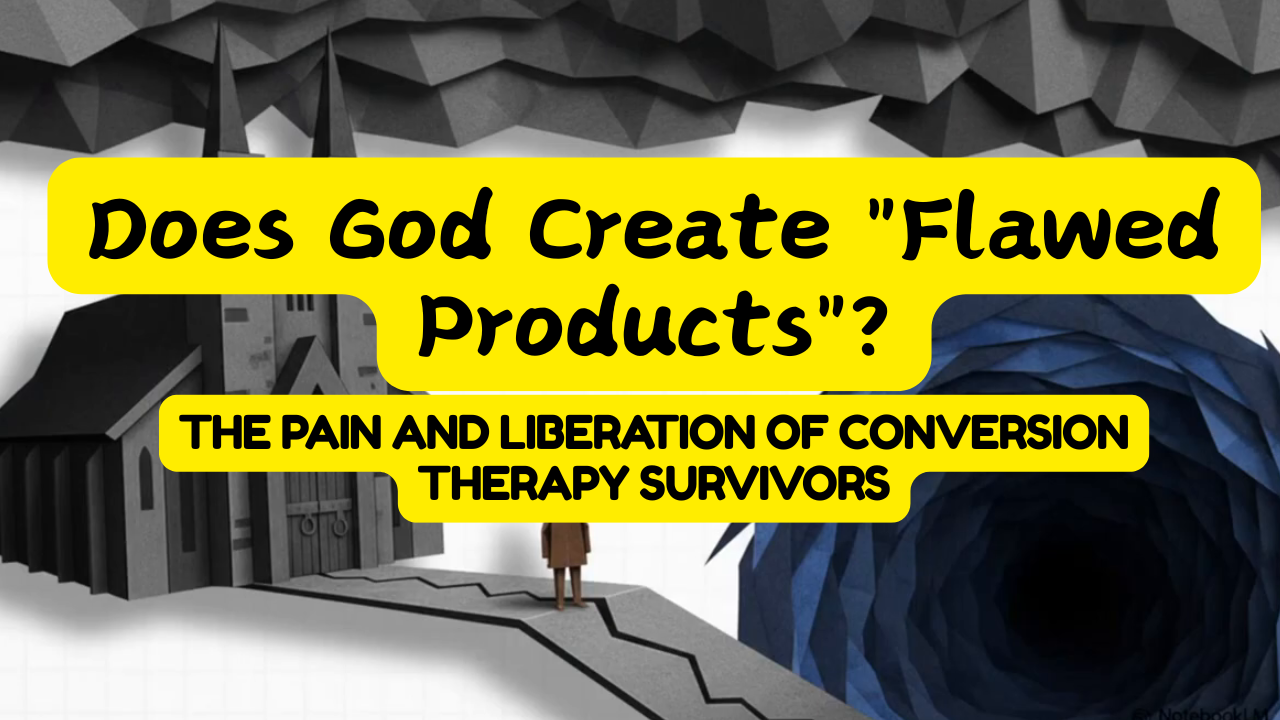
Their testimonies revealed that these interventions, though cloaked in pious appeals to “chastity” and “restoring the order of creation”, fundamentally operated by implanting deep “spiritual shame”. Participants were systematically conditioned to view themselves as “defective goods rejected by God”. This approach not only ruptured their relationships with their families of origin, but also inflicted catastrophic damage on their faith, plunging believers into utter despair when the promised “restoration” inevitably failed to materialise. [2]
2. The Diagnosis of Science: Not Healing, but Dehumanising Harm
Faced with this consistent pattern of psychological wreckage, the global medical and psychiatric establishment has arrived at an unambiguous consensus: sexual orientation and gender identity are natural variations of human diversity, not mental disorders. Any attempt to alter sexual orientation has no valid scientific foundation and carries immense clinical harm.
Warnings from the Scientific Consensus
Major global bodies, including the World Health Organization (WHO), the American Psychological Association (APA), and Britain’s Royal College of Psychiatrists, have issued comprehensive policy statements highlighting two fundamental conclusions: [6]
- Inefficacy: There is no credible scientific evidence that sexual orientation can be safely or permanently changed through external psychological or pastoral interventions.
- Severe Harm: Sexual Orientation Change Efforts (SOCE) precipitate grave psychiatric morbidity. Survivors disproportionately suffer from major depressive disorders, severe anxiety, complex PTSD, pervasive self-stigma, and sharply elevated risks of suicide attempts.
A landmark empirical study conducted in Hong Kong by the Society of True Light in collaboration with university researchers [4] revealed that among local individuals who had undergone conversion therapy, 83.3 per cent had experienced suicidal ideation , and nearly 40 per cent met the diagnostic criteria for clinical depression. These sobering figures mirror the findings of the British Government’s independent evidence assessment on conversion practices published in 2021. [7]
From ‘Seeking a Cure’ to Affirmative Practice
These scientific insights have catalysed a paradigm shift within clinical practice towards LGBTQ+ Affirmative Practice (also known as Affirmative Therapy). [8]
Affirmative therapy completely discards the premise that sexual orientation is a pathology requiring remediation. Instead, it seeks to:
- Support authentic self-acceptance , alleviating the profound “minority stress” induced by societal marginalisation and religious rejection.
- Assist clients in integrating their faith and sexual identity , dismantling the false and destructive dichotomy that forces believers to choose between their God and their integrity.
- Strengthen psychological resilience and social support networks , empowering individuals to lead healthy, dignified lives.
When robust medical evidence demonstrates that conversion therapies do not heal, but rather engineer profound pathology and despair, the continued perpetuation of these practices violates basic medical ethics. In theological terms, it amounts to the active mutilation of God’s handiwork.
3. Theological and Ethical Reconstruction: When Reason Meets Co-Creation
Why do conservative religious communities remain so stubbornly attached to conversion therapies? At the root of their insistence lies a specific, historical reading of Natural Law : the conviction that God designed male and female bodies solely for biological reproduction, that any departure from this pattern is “unnatural”, and that pastoral fidelity requires “repairing” the individual back to that perceived design.
Yet in his seminal work, New Directions in Sexual Ethics , the prominent Catholic moral theologian Kevin T. Kelly exposes the critical philosophical flaw in this mindset. [3] Kelly demonstrates that classical sexual ethics has frequently fallen into the trap of “physicalism”—conflating what is truly “natural” with mere biological or physiological mechanics. When we return to the deeper roots of the theological tradition, a vastly different, emancipatory framework emerges.
1. Redefining Natural Law: ‘Reasonable is Natural’
Kelly reminds us that human beings, unlike animals, do not navigate existence purely through instinct or bodily mechanics. God endowed humanity with intellect and reason, creating us as moral agents capable of discerning good and evil. For this reason, the mediaeval doctor of the church Saint Thomas Aquinas explicitly defined natural law not as a set of static biological codes, but as “the rational creature’s participation in the eternal law” ( lex naturalis nihil aliud est quam participatio legis aeternae in rationali creatura ). [9]
Building on this Thomistic foundation, Kelly puts forward an illuminating principle:
In the moral context of natural law, what is ‘natural’ truly means what is ‘reasonable’. [3]
If humanity is to live in accordance with its authentic nature, we must live reasonably. What, then, constitutes reasonable action? Consider a medical intervention—such as contraception, fertility treatment, or gender-affirming healthcare. While technically “artificial”, if such an intervention protects human dignity, fosters health, and enriches relational flourishing, then in the moral framework of natural law, it is far more “natural” than passively yielding to blind biological processes. Conversely, if an inherited tradition claiming to be “natural” results in systemic cruelty, psychological humiliation, and the destruction of human lives, that tradition is deeply unreasonable—and, by definition, profoundly unnatural . [3]
This theological shift provides a compelling lens through which to evaluate conversion therapy:
- The Unreasonable is ‘Unnatural’: Conversion therapy seeks to suppress a person’s core identity, resulting in severe clinical depression, PTSD, and suicide. A practice that disintegrates human personhood and crushes the spirit is profoundly unreasonable. Therefore, conversion therapy is intrinsically unnatural .
- The Reasonable is ‘Natural’: When a queer Christian embraces their created distinctiveness and enters into a loving, reciprocal relationship marked by mutual fidelity and responsibility, that relationship—even though non-procreative—actively promotes psychological wholeness and holiness. Because it nurtures human dignity, it is supremely reasonable. Consequently, LGBTQ+ love and self-acceptance stand in complete harmony with moral nature .
As Kelly argues, human intellect, creativity, and medical science are gifts of creation. Utilizing scientific knowledge to alleviate human misery is itself a natural human activity. “Artificial” interventions—whether affirmative psychotherapy or statutory legislation outlawing conversion practices—are, in principle, morally “natural” whenever they defend life and human dignity. [3]
2. The Pilgrim Church on the Way
Many conservative Christians fear that revising inherited traditions risks dismantling the foundations of the faith. Yet Kelly draws our attention back to the Second Vatican Council’s vision of the Church as the “Pilgrim Church” ( Ecclesia Peregrina ). [10]
We are pilgrims journeying through the winds and tides of history, not comfortable settlers who have already arrived at absolute knowledge. A pilgrim posture requires what Kelly terms “pilgrim openness”—a humble willingness to listen to fresh human experiences and insights. As the Pastoral Constitution Gaudium et Spes (§44) eloquently affirms, the Church benefits immensely from the historical evolution of human experience and the advances of modern science, which help reveal the full mystery of created nature and illuminate revealed truth. [10]
When confronted with the agony of conversion therapy survivors, the Church must not retreat behind the authoritarian posture of causa finita est (“the matter is settled”). Rather, it is called to adopt the humble posture of “Yes, but…”—attentively listening to the lived experience of survivors, repenting for pastoral harm born of obsolete knowledge, and allowing the Holy Spirit to guide its path. The Vatican Study Group 9’s critique of reparative therapy exemplifies precisely this pilgrim journey in action. [2]
3. The True Meaning of ‘Playing God’: Stewards of Ongoing Creation
Whenever societies move to ban conversion therapy or support gender-affirming healthcare, religious conservatives often level the accusation that humans are “playing God”, meddling in an untouchable divine blueprint.
Kelly offers a devastating rebuttal to this objection: God’s creation is not a static, finished, ‘do-not-touch’ clockwork mechanism. Rather, creation is an ongoing, dynamic process ( creatio continua ). God invites human beings, through their God-given reason, to act as ‘co-creators’ alongside the Divine. [3]
When we advocate for legal bans against conversion practices to protect vulnerable people from pseudo-scientific cruelty, we are not usurping divine authority. We are exercising our highest duty of faithful stewardship. By contrast, clinging blindly to discredited practices that leave human souls shattered and suicidal in the name of piety is not playing God—it is “playing the fool” . [3]
As the theologian Nicholas Lash aptly observed, “The forgiveness and healing of the world is the completion of creation.” [11] When wounded healers deploy rational love and scientific wisdom to bind up the brokenhearted in a fractured world, they are actively participating in God’s ongoing work of creation.
Conclusion: Beholding Creation Through Rational Love
We are all pilgrims on the way.
From Kevin T. Kelly’s pioneering theological resistance against the moral panic of the 1980s AIDS crisis to today’s worldwide movement to criminalise conversion practices, history demonstrates one immutable truth: human reason is not the adversary of faith, but the illuminating lamp of love and justice.
If an inherited custom parading as “holy” yields only destruction, despair, and death, it is neither reasonable nor natural. If an ethical progression enables love, integrity, and human dignity to flourish in freedom, it is the authentic work of the Holy Spirit. [12]
Every LGBTQ+ believer is a “sensitive and innocent creature of God”. [3] Ceasing our futile attempts to violently remake them, and choosing instead to embrace them with scientific reason and theological grace, is no cowardly concession to secular culture. It is the most faithful act of worship we can offer to the Creator who looked upon all that was made, and declared it very good.
📺 Watch / Listen on YouTube and Podcast:
Notes and Citations
[1] UK Cabinet Office and Government Equalities Office, “The King’s Speech 2024: background briefing notes,” (July 2024), 62–64. During the State Opening of Parliament in July 2024, King Charles III formally announced that the British Government would introduce legislation to ban conversion practices targeting sexual orientation and gender identity (Conversion Practices Bill). ↩
[2] Vatican General Secretariat of the Synod, Study Group 9: Some theological and ethical issues around sexuality and affection – Final Report (Vatican City: General Secretariat of the Synod, May 2026). This concluding report from the Synod on Synodality’s Study Group 9 marked the first time the Holy See officially received testimonies from sexual minority believers, explicitly highlighting the profound psychological and spiritual trauma inflicted by “reparative therapies”. ↩¹ ↩² ↩³ ↩⁴
[3] Kevin T. Kelly, New Directions in Sexual Ethics: Moral Theology and the Challenge of AIDS (London: Geoffrey Chapman, 1998), 24–42. Kelly offers an extensive critique of physicalism in traditional Catholic moral theology, advancing the foundational principle that “Reasonable is Natural” and arguing that human beings participate as co-creators in the ongoing unfolding of God’s creation. ↩¹ ↩² ↩³ ↩⁴ ↩⁵ ↩⁶ ↩⁷
[4] Society of True Light and the University of Hong Kong Research Team, Research Report on the Experiences and Impact of Sexual Orientation Change Efforts (SOCE) Among Sexual Minorities in Hong Kong (2022/2023). The study revealed that 83.3% of participants who underwent conversion efforts experienced suicidal ideation, and nearly 40% met clinical thresholds for depression. Alvin’s narrative represents a typical case documented in this qualitative study. Official project portal: https://true-light.asia . ↩¹ ↩² ↩³
[5] Garrard Conley, Boy Erased: A Memoir of Identity, Faith, and Family (New York: Riverhead Books, 2016). ↩¹ ↩²
[6] American Psychological Association (APA), “Resolution on Appropriate Affirmative Responses to Sexual Orientation Distress and Change Efforts,” American Psychologist 65, no. 4 (2010): 290–304; World Health Organization (WHO), “Curing” Sexuality: The Harmful Practice of Conversion Therapy (Geneva: WHO, 2020). ↩
[7] Coventry University, Conversion Therapy: An Evidence Assessment and Qualitative Study , commissioned by the UK Government Equalities Office (London: HM Government, 2021). ↩
[8] American Psychological Association (APA), “Guidelines for Psychological Practice with Sexual Minority Persons,” American Psychologist 76, no. 7 (2021): 1086–1103. Affirmative Practice rejects any effort to alter sexual orientation, focusing instead on validating sexual diversity, helping clients alleviate minority stress, and integrating personal spirituality with relational health. ↩
[9] Thomas Aquinas, Summa Theologiae , I-II, q. 94, a. 2 (“lex naturalis nihil aliud est quam participatio legis aeternae in rationali creatura” / Natural law is nothing other than the rational creature’s participation in the eternal law). See also: Kevin T. Kelly, New Directions in Sexual Ethics , 28–30. ↩
[10] Second Vatican Council, Pastoral Constitution on the Church in the Modern World Gaudium et Spes (7 December 1965), no. 44. The constitution emphasises that the Church must draw upon human history, scientific progress, and evolving human experience to deepen its understanding of created nature and divine revelation. See also: Dogmatic Constitution on the Church Lumen Gentium , Chapter VII (“The Pilgrim Church”). ↩¹ ↩²
[11] Nicholas Lash, Believing on the Edge (London: SCM Press, 1995), 188; cited in Kevin T. Kelly, New Directions in Sexual Ethics , 38. Kelly references Lash’s insight to affirm that humanity’s rational healing of brokenness in history is a co-creative act that brings creation towards completion. ↩
[12] Rosemary Radford Ruether, Sexism and God-Talk: Towards a Feminist Theology (London: SCM Press, 1983), 18–20. Ruether establishes the critical theological criterion that whatever diminishes or distorts the full humanity of persons cannot reflect the divine will, whereas whatever promotes human dignity and flourishing is the authentic work of the Spirit. This criterion is here applied to the evaluation of pastoral and sexual ethics. ↩